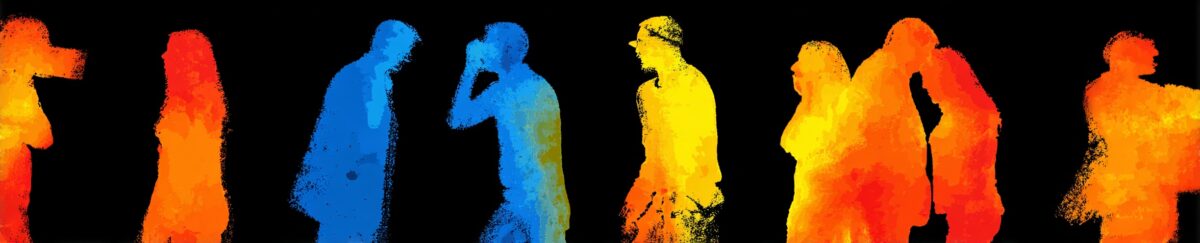
How emotions show up in the body
In 2014, Lauri Nummenmaa and his team from Finland’s University of Turku published a landmark paper about how people from different language backgrounds perceive different emotions in their bodies. While the data he collected was subjective, it pointed to a remarkable consistency of human emotional experiences that transcends language, culture and geography. Investigation of the “hot” and “cold” zones his team uncovered align with well-documented physiological changes about how emotions work that you can examine below.
EMO-SCAN 9000
Tap an emoji below, and then click hot spots on the silhouette to learn more
about the bodily processes that drive your feelings.
Anger
In Nummenmaa et al.’s maps, anger lights up the head, chest, and arms with slightly reduced activity in the legs, matching a body poised to confront and act.
References
- Hendricks, L., Bore, S., Aslinia, D., & Morriss, G. (2013). The effects of anger on the brain and body. In National forum journal of counseling and addiction (Vol. 2, No. 1, pp. 2-5).
- Huis In ‘t Veld, E. M., van Boxtel, G. J., & de Gelder, B. (2014). The Body Action Coding System II: muscle activations during the perception and expression of emotion. Frontiers in Behavioral Neuroscience, 8, 330.
- Nummenmaa, L., Glerean, E., Hari, R., & Hietanen, J. K. (2014). Bodily maps of emotions. Proceedings of the National Academy of Sciences, 111(2), 646-651.
- Proverbio, A. M., & Cerri, A. (2022). The recognition of facial expressions under surgical masks: the primacy of anger. Frontiers in Neuroscience, 16, 864490.
- Schum, J. L., Jorgensen, R. S., Verhaeghen, P., Sauro, M., & Thibodeau, R. (2003). Trait anger, anger expression, and ambulatory blood pressure: A meta-analytic review. Journal of Behavioral Medicine, 26(5), 395-415.
- Babic, T., & Browning, K. N. (2014). The role of vagal neurocircuits in the regulation of nausea and vomiting. European Journal of Pharmacology, 722, 38-47.
- Lang, I. M. (2023). Physiology of the digestive tract correlates of vomiting. Journal of Neurogastroenterology and Motility, 29(1), 20.
- Meissner, K., Muth, E. R., & Herbert, B. M. (2011). Bradygastric activity of the stomach predicts disgust sensitivity and perceived disgust intensity. Biological Psychology, 86(1), 9-16.
- Nummenmaa, L., Glerean, E., Hari, R., & Hietanen, J. K. (2014). Bodily maps of emotions. Proceedings of the National Academy of Sciences, 111(2), 646-651.
- Rubio-Godoy, M., Aunger, R., & Curtis, V. (2007). Serotonin–a link between disgust and immunity? Medical Hypotheses, 68(1), 61-66.
- de Groot, J. H., Kirk, P. A., & Gottfried, J. A. (2020). Encoding fear intensity in human sweat. Philosophical Transactions of the Royal Society B, 375(1800), 20190271.
- Gomes, N., Pause, B. M., Smeets, M. A., & Semin, G. R. (2023). Comparing fear and anxiety chemosignals: Do they modulate facial muscle activity and facilitate identifying facial expressions? Chemical Senses, 48, 1-14.
- Hyman, P. E., & Cocjin, J. (2005). Colon motility during a panic attack. Psychosomatic Medicine, 67(4), 616-617.
- Nummenmaa, L., Glerean, E., Hari, R., & Hietanen, J. K. (2014). Bodily maps of emotions. Proceedings of the National Academy of Sciences, 111(2), 646-651.
- Mayer, E. A. (2000). Spinal and supraspinal modulation of visceral sensation. Gut, 47(suppl 4), iv69-iv72.
- Rosa, J., Myskiw, J. C., Furini, C. R., Sapiras, G. G., & Izquierdo, I. (2014). Fear extinction can be made state-dependent on peripheral epinephrine: role of norepinephrine in the nucleus tractus solitarius. Neurobiology of Learning and Memory, 113, 55-61.
- Zagvazdin, Y., Mashukova, A., & Purvis, C. (2025). Sympathetic nerves, salivary secretion, and the parched mouth of fear: unraveling historical perspectives on persistent contradiction in physiology textbooks. Advances in Physiology Education, 49(1), 105-126.
- Alam, M., Faraz, A., & Zeb, A. (2023). Neurotransmitters and tourism happiness: Unraveling the link between brain chemistry and tourist experience. Global Social Sciences Review, 8(4), 42-48.
- Coles, N. A., March, D. S., Marmolejo-Ramos, F., Larsen, J. T., Arinze, N. C., Ndukaihe, I. L., … & Liuzza, M. T. (2022). A multi-lab test of the facial feedback hypothesis by the Many Smiles Collaboration. Nature Human Behaviour, 6(12), 1731-1742.
- Harmon-Jones, E., & Harmon-Jones, C. (2021). On defining positive affect (PA): Considering attitudes toward emotions, measures of PA, and approach motivation. Current Opinion in Behavioral Sciences, 39, 46-51.
- Hartmann, M., Lenggenhager, B., & Stocker, K. (2023). Happiness feels light and sadness feels heavy: introducing valence-related bodily sensation maps of emotions. Psychological Research, 87(1), 59-83.
- Nummenmaa, L., Glerean, E., Hari, R., & Hietanen, J. K. (2014). Bodily maps of emotions. Proceedings of the National Academy of Sciences, 111(2), 646-651.
- Terry, D. A., & Pirtle, P. L. (2001). Learning to smile: the neuroanatomic basis for smile training. Journal of Esthetic and Restorative Dentistry, 13(1), 20-27.
- Cudjoe, M. M. (2023). From sadness to heart disease: A comprehensive review on the correlation between depression and cardiovascular disease. Asian Journal of Research in Cardiovascular Diseases, 5(1), 101-115.
- Freed, P. (2009). Is sadness an evolutionarily conserved brain mechanism to dampen reward seeking? Depression may be a “sadness disorder”. Neuropsychoanalysis, 11(1), 61-66.
- Lechien, J. R., Baudouin, R., Hans, S., & Akst, L. M. (2023). History of otolaryngology: Globus pharyngeus as “globus hystericus”. Otolaryngology–Head and Neck Surgery, 168(4), 889-892.
- Nummenmaa, L., Glerean, E., Hari, R., & Hietanen, J. K. (2014). Bodily maps of emotions. Proceedings of the National Academy of Sciences, 111(2), 646-651.
- Singh, S., & Basu, S. (2020). The human lacrimal gland: historical perspectives, current understanding, and recent advances. Current eye research, 45(10), 1188-1198.
- Blouin, J. S., Siegmund, G. P., & Inglis, J. T. (2007). Interaction between acoustic startle and habituated neck postural responses in seated subjects. Journal of Applied Physiology, 102, 1574-1586.
- Chen, K. H., Aksan, N., Anderson, S. W., Grafft, A., & Chapleau, M. W. (2014). Habituation of parasympathetic-mediated heart rate responses to recurring acoustic startle. Frontiers in Psychology, 5, 1288.
- Nummenmaa, L., Glerean, E., Hari, R., & Hietanen, J. K. (2014). Bodily maps of emotions. Proceedings of the National Academy of Sciences, 111(2), 646-651.
- Reisenzein, R., Bördgen, S., Holtbernd, T., & Matz, D. (2006). Evidence for strong dissociation between emotion and facial displays: the case of surprise. Journal of Personality and Social Psychology, 91(2), 295.
- Roelofs, K. (2017). Freeze for action: neurobiological mechanisms in animal and human freezing. Philosophical Transactions of the Royal Society B: Biological Sciences, 372(1718), 20160206.
Vibe coded (and then ruthlessly edited and fact-checked)
with love and buttercups by Geoff Crane and ChatGPT (2025).
Geoff Crane designs research-backed tools to make so-called “soft skills” concrete, measurable, and deeply human. After more than two decades in industry and another decade in personal intelligence research and program design, his work now supports coaches, educators, and organisations that want to understand people more clearly and help them grow with care.
Curious about your own patterns of emotion, connection, and motivation? You can complete the MIPI Short for free on my home page and receive a brief feedback report to start exploring your personal intelligence.

