
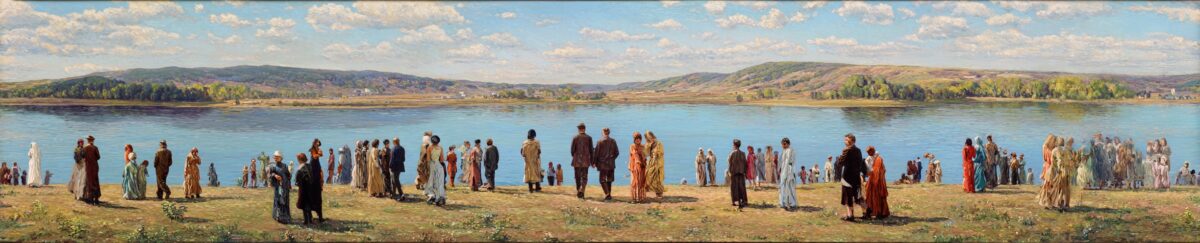

Still human: Knowing, feeling and doing across time
Across time and culture, people have tried to understand a few basic things: how we know, how we feel, and how we act in the world. This project brings together ideas from many traditions—philosophical, spiritual, psychological, and oral—to explore those questions side by side.
The map uses a modern interpretive lens inspired by the Multidimensional Inventory for Personal Intelligence (the MIPI), but it is not presented as a universal template. What it reflects, instead, is my observation that certain human concerns recur across very different traditions, even when they are expressed through entirely different languages, symbols, and practices. This is not an attempt to suggest that these traditions were saying the same things—or even asking the same questions in the same way.
One of the surprises for me was discovering how often traditions I assumed were closely aligned turned out to approach these questions quite differently. Those differences matter, and they change how each tradition needs to be understood on its own terms.
Still, spending time with this map gave me an unexpected sense of grounding. Seeing how people with vastly different histories and ways of life have wrestled with similar human concerns, each through their own frameworks, made me feel part of something larger. And in that context, I no longer felt quite so small.
The goal here is comparison, not simplification; curiosity, not judgment. Think of this map as an invitation to explore how different cultures have approached knowing, feeling, and doing—while remaining attentive to the uniqueness of each tradition’s voice.
How to Read This Map
This map uses a contemporary analytic lens—often described as knowing, feeling, and doing—to help modern readers explore how different traditions have described inner life, moral development, and human action.
Some readers may recognise this lens from contemporary tools such as the Multidimensional Inventory for Personal Intelligence. The triad is used here only as a loose orientation device, not as a claim about how minds are “really” structured across cultures.
The concepts shown are not presented as equivalent psychological systems, nor as replacements for the traditions’ own frameworks. They are interpretive mappings intended to support reflection and dialogue, not to impose a single worldview or measure traditions against one another.
Across time and culture, humans have grappled with questions of knowing, feeling, and acting—sometimes as faculties, sometimes as practices, sometimes as relational or spiritual orientations. This map highlights that continuity while honouring the profound and important differences in how those struggles have been conceptually understood.
About This Map
This map is a comparative, interpretive project. It does not claim that human cultures have understood inner life, morality, or action in the same way, nor that any single framework applies universally across time or tradition.
Instead, it aims to show something more modest and more human: that across history and culture, people have grappled—in profoundly different ways—with questions of knowing, feeling, and acting. The dimensions used here (knowing, feeling, doing) are contemporary analytic lenses, offered as aids for reflection and comparison rather than as replacements for any tradition’s own concepts, cosmologies, or practices.
Where traditions do not divide inner life into discrete components, or where such divisions would be misleading, we explicitly acknowledge this. In several cases, especially for living oral traditions, the map uses presence markers and intentionally cautious language to avoid implying origins, boundaries, or reductions that the traditions themselves would not recognize.
This project is shaped by a strong commitment to care: care for cultural difference, care for translation limits, and care not to cause harm or misrepresentation. At the same time, it holds that respectful comparison—when done transparently and humbly—can be a way of honouring shared human inquiry rather than flattening it.
If something here feels incomplete, compressed, or unsatisfying, that response is valid. No map of this kind can be neutral or exhaustive. What it can do is remain open about its lens, its limits, and its intentions—and invite dialogue rather than closure.
Selected scholarly context and citations
Geertz, C. (1973). The Interpretation of Cultures. Basic Books.
Henrich, J., Heine, S. J., & Norenzayan, A. (2010). The Weirdest People in the World? Behavioral and Brain Sciences, 33(2–3), 61–83.
Lillard, A. (1998). Ethnopsychologies: Cultural Variations in Theories of Mind. Psychological Bulletin, 123(1), 3–32.
Markus, H. R., & Kitayama, S. (1991). Culture and the Self: Implications for Cognition, Emotion, and Motivation. Psychological Review, 98(2), 224–253.
Shweder, R. A. (1991). Thinking Through Cultures: Expeditions in Cultural Psychology. Harvard University Press.
Wierzbicka, A. (1999). Emotions Across Languages and Cultures. Cambridge University Press.
Vibe coded with love and buttercups by Geoff Crane and ChatGPT (2026).
Geoff Crane designs research-backed tools to make so-called “soft skills” concrete, measurable, and deeply human. After more than two decades in industry and another decade in personal intelligence research and program design, his work now supports coaches, educators, and organisations that want to understand people more clearly and help them grow with care.
Curious about your own patterns of emotion, connection, and motivation? You can complete the MIPI Short for free on my home page and receive a brief feedback report to start exploring your personal intelligence.
