THE MIPI FRAMEWORK

Some patterns look like weakness until you understand what they’re trying to do.

Personal Intelligence (PI) describes the non-cognitive emotional, social and motivational competencies that shape how we understand ourselves, relate to others and move through the world. It’s not a personality type or a diagnosis, but a map of patterns that can rest and shift over time.

THE STRUCTURE

Three structures, one lived pattern

Each domain offers a different view of how you function.
Together they form a complete map of Personal Intelligence.


Emotional (E)

Identifying and working with emotional experience – both your own and others’.


Social (S)

Belonging, performing under observation and taking initiative in social environments.


Motivational (M)

Sustaining effort, influencing others and persisting through obstacles.

WHY IT MATTERS

Changes in these competencies impact everything

Personal Intelligence helps explain why people react or stall the way they do and where focus may be most helpful.

When access is constrained

  • Difficulty identifying or naming feelings
  • Interpersonal conflict or social withdrawal
  • Performance anxiety and avoidance
  • Inconsistent follow-through on goals
  • Trouble managing stress and change
  • Feeling stuck or directionless

When access is stronger

  • Clearer emotional self-awareness
  • More stable, satisfying relationships
  • Better conflict navigation
  • Steadier focus and follow-through
  • Greater resilience and sense of meaning
  • Confidence in navigating change


Emotional Competencies

How you notice, understand and work with your feelings

The ability to notice, identify and make sense of emotional signals in yourself and others.

On the left, people tend to stay steady during emotional moments and don’t get swept up easily. They’re reliable under pressure and slow to react.

On the right, people notice emotional shifts and pick up nuance in others. They tend to feel things vividly and read signals early.

The tendency to reflect on inner experiences, patterns and motives.

On the left, people are more action-focused and don’t spend a lot of time analyzing themselves. They prefer to keep things moving and straightforward.

On the right, people naturally look inward, connect dots and explore why they feel and act as they do. They often bring rich insight into their own patterns.

The way someone focuses, shift and sustains attention over time.

On the left, people are comfortable moving between tasks and noticing many things at once. They can pivot quickly when situations change.

On the right, people can sustain focus and stay with a task for longer stretches. They tend to dive deeply and concentrate on what’s in front of them.

The ability to put feelings into words and share them with others.

On the left, people are more reserved about naming emotions and may communicate care or concern through actions rather than language.

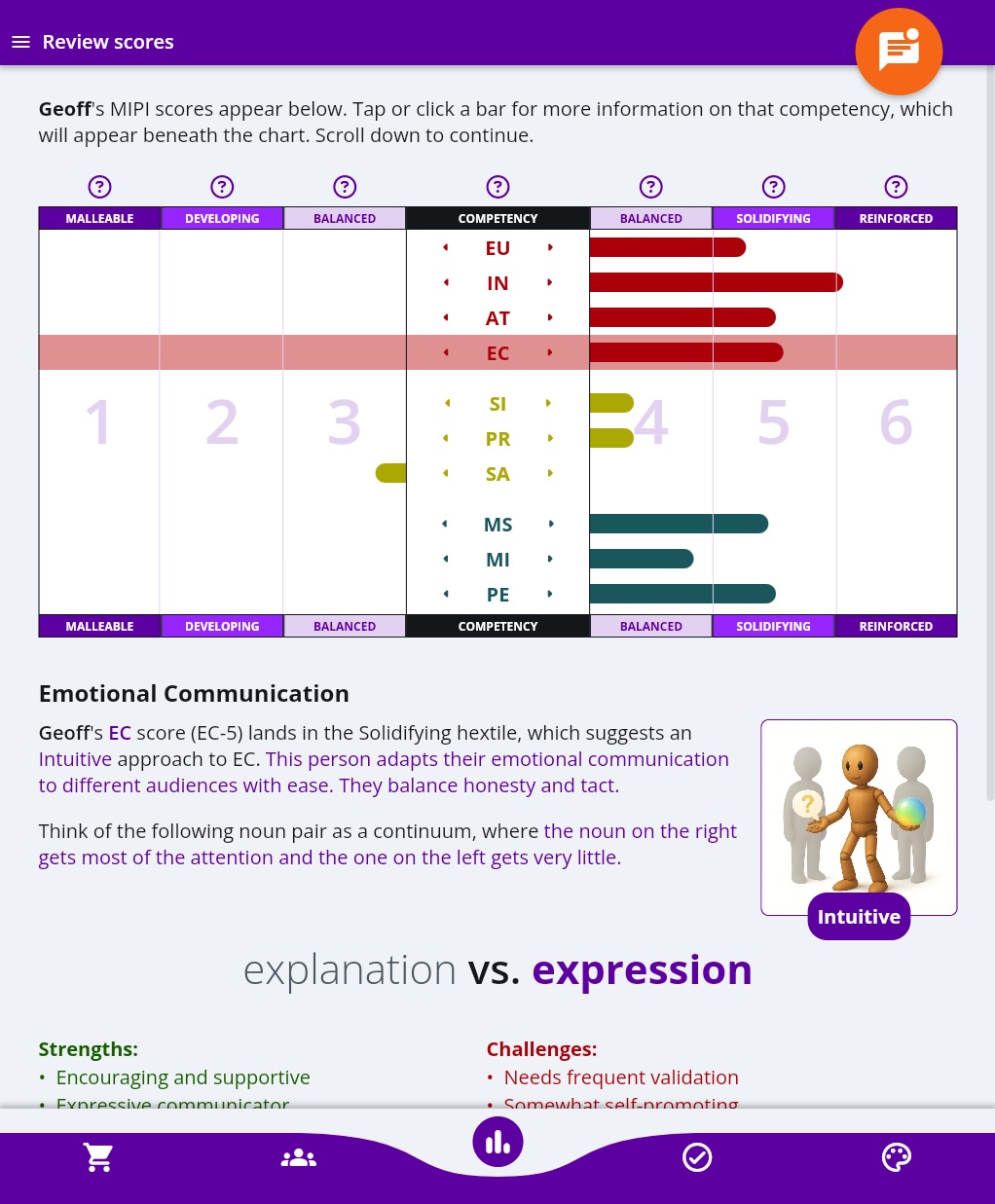
On the right, people find it easier to describe what they feel and why. They often help others feel seen by giving feelings clear, respectful language.


Social Competencies

How you belong, perform and make decisions through social spaces

The degree to which someone feels connected to, and supported by, the people and communities around them.

On the left, people are comfortable spending time on their own and often value independence and self-reliance.

On the right, people tend to feel more plugged into networks and support. They actively nurture relationships and are more likely to lean on others when needed.

How someone responds when they need to show up and be seen – presenting, interviewing, leading or performing.

On the left, people often prefer behind-the-scenes roles and may approach visible moments with caution and careful preparation.

On the right, people are more at ease being visible and taking the spotlight. They can find energy in presenting, performing or leading from the front.

The confidence to initiate contact, express needs and influence social situations.

On the left, people tend to have a gentler presence and often wait for others to initiate. They may prioritize harmony and listening.

On the right, people are more comfortable starting conversations, expressing opinions and steering interactions when it feels appropriate.


Motivational Competencies

How you sustain effort, believe in change and motivate others

The belief that you can move toward the goals and futures that matter to you.

On the left, people are cautious about commitments and like to be realistic. They may prefer to move in smaller, carefully chosen steps.

On the right, people more readily believe change is possible for them. They’re inclined to take on challenges and trusst that effort can pay off.

The capactiy to energize, encourage and guide others toward action.

On the left, people often influence quietly by example and through one-to-one support. They may prefer gentle encouragement over big gestures.

On the right, people are more comfortable rallying others around ideas or goals. They tend to energize groups and speak persuasively about matters.

How someone stays engaged with effort over time, especially when things are hard or repetitive.

On the left, people are more willing to pivot when something no longer feels workable or aligned. They often try to protect energy and avoid grinding for its own sake.

On the right, people are inclined to stay with a task through difficulty and delay. They can keep working toward long-term goals seven when progress is slow.

HISTORY

Where this came from

Origins of the modern PI framework

1 / 6

1. EI models were too narrow

Early emotional intelligence tools focused on a small slice of emotional life. They rarely captured difficulties like alexithymia, limited emotional vocabulary, attentional drift or trouble putting feelings into words.

PI broadens the lens to include Emotional Understanding, Introspectiveness, Attentiveness and Emotional Communication.

APPLICATIONS

How PI is used

Self-understanding

Personal reflection and growth

Learn more →

Coaching

Clearer client insight

Learn more →

Training

Tailored development

Learn more →

Research

Academic study

Learn more →

RESEARCH

Further Reading

For those who want to go deeper into the theory and measurement of Personal Intelligence
The Multidimensional Inventory for Personal Intelligence (MIPI) is the assessment used across Adaptimist tools and research. It measures the three families of Personal Intelligence - emotional, social and motivational competencies - and combines them into a single, interpretable PI profile.

Completion time
Extremely short or unusually long completion times help identify rushed, distracted or overly effortful responding, providing context for the rest of the profile.
Omitted items
It is very difficult to intentionally skip items on the online version of the assessment. If a respondent skips anyway, there may be uncertainty, discomfort or disengagement.
Consistency
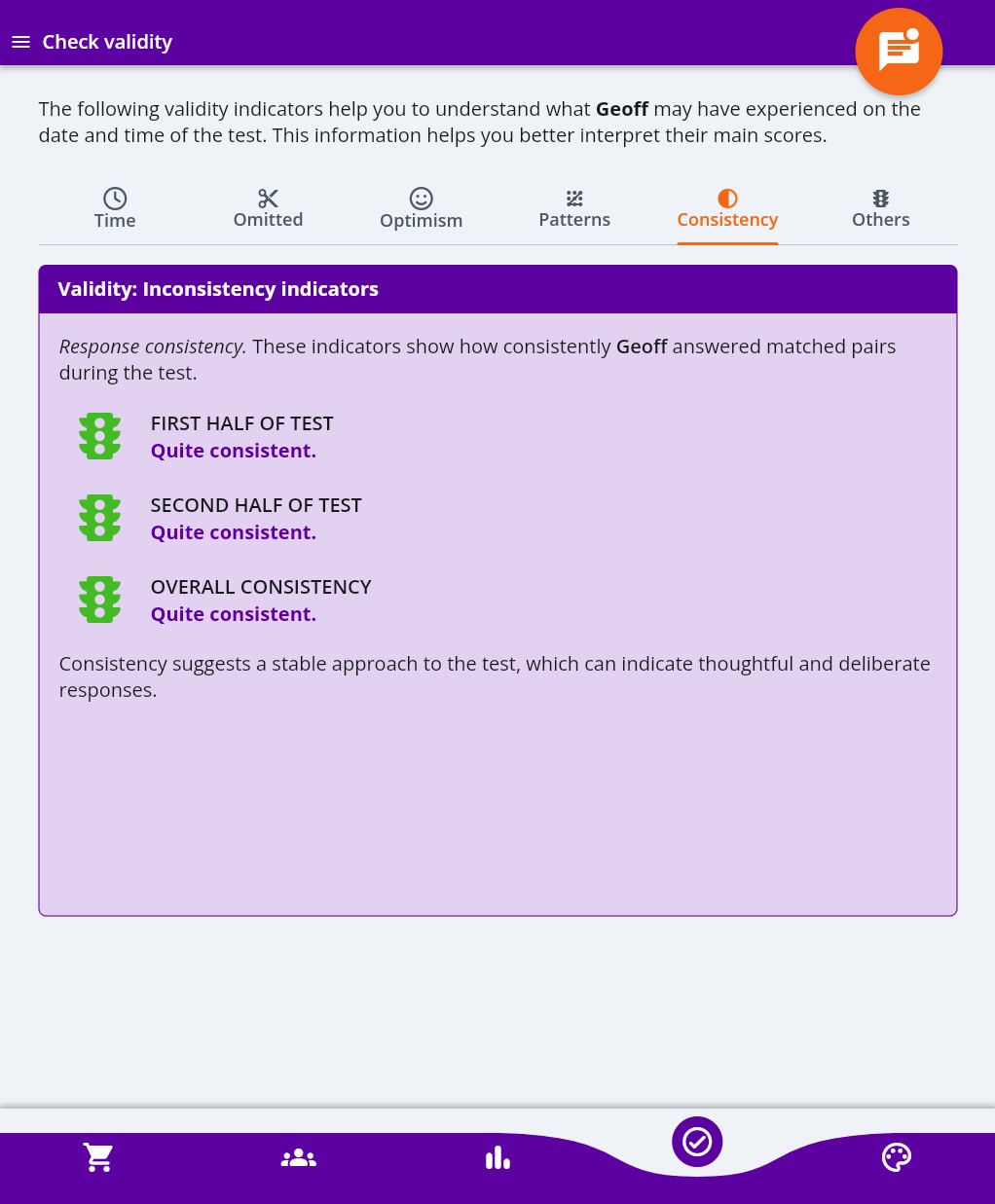
Consistency checks whether related items point in the same general direction. Lower consistency suggests distraction or difficulty.
Positive impression
Sometimes people complete assessments with a preconceived idea of what the end state should look like. This helps capture that.

To keep those scores meaningful, the MIPI includes several validity indicators. These don't "judge' anyone, they simply help flag when responses may have been rushed, distracted or strongly shaped by mood or self-presentation, so results can be interpreted with appropriate care.

Optimism
Optimism is separated from PI so scores aren't inflated by temporary positive mood, unlike many older EI tools.
Response distribution
Using only extremes (or only the midpoint) may imply broader response tendencies that extend beyond the test. These are usually worth exploring.
Randomness
We compare each response to a sample of random numbers to determine whether or not the respondent has randomly clicked items instead of considering each one in turn. This is a useful screen for research.

The Multidimensional Inventory for Personal Intelligence (MIPI) is the assessment used across Adaptimist tools and research. It measures the three families of Personal Intelligence - emotional, social and motivational competencies - and combines them into a single, interpretable PI profile.

Crane, A. G., & Henning, C. T. (2022, July). From emotional intelligence to intelligence: New directions in the assessment of emotional and social competencies. The Score, APA Division 5 newsletter.
Parker, J. D. A. (2022, July). When will Emotional Intelligence have relevance for clinical psychology? The Score, APA Division 5 newsletter.
Crane, A. G., Cormier, M. L., Taylor, R. N., & Parker, J. D. A. (2020). Teaching emotional and social competencies: Efficacy of a work readiness program designed for vulnerable youth. Work, 67(2), 407-418.

The Multidimensional Inventory for Personal Intelligence (MIPI) is the assessment used across Adaptimist tools and research. It measures the three families of Personal Intelligence - emotional, social and motivational competencies - and combines them into a single, interpretable PI profile.

Parker, J. D. A. (2022). The Multidimensional Inventory for Personal Intelligence (MIPI): Technical manual. Peterborough, ON: Adaptimist Insights.
Van Rens, S. M., Henning, C. T., Crane, A. G., MacIntosh, A., Sitarenios, G. & Parker, J. D. A. (2025). Validating a short measure of Personal Intelligence: A multimethod assessment approach. Personality and Individual Differences, 237, 113052.
Van Rens, S. M., Henning, C. T., Crane, A. G., Summerfeldt, L. J. & Parker, J. D. A. (2025). Trait Emotional Intelligence revisited: Development and validation of a short measure for Personal Intelligence. Personality and Individual Differences, 224, 112641.