THE LIBRARY

A public window into the applied library we have built across the MIPI competencies.

A lot of soft-skills advice assumes the same problem always needs more of the same competency. We built this library because that assumption is often wrong.

When a competency is less available, people do not simply vanish from the problem. They still show up. They compensate. They borrow whatever other tools they have. Sometimes those tools do a job. Sometimes they are poorly matched to the work. This page does not try to catalogue the full collection. It opens just enough of it to make the shape of the library legible.

Left-facing needs

Sometimes the problem is not that a person does not care, or never shows up. It is that the relevant capacity is harder to access, so other tools have to fill the gap.

Getting started Finding words Holding focus

Right-facing needs

Sometimes the capacity is already very available, but it becomes costly, overused, poorly bounded, or simply out of fit with the moment.

Slowing down Setting boundaries Loosening overcontrol

THE REFRAME

What this library helps people see

Less availability does not mean absence from the situation. People still deal with pressure, conflict, unfinished work, and emotional strain. They often compensate with substitute tools. The issue is that the substitute tool may not fit the actual demand.

People still show up

They do not disappear from important problems just because one competency is less available. They work with what they have.

Compensation is not the same as fit

A substitute tool may be understandable, and sometimes impressive. It can still be poorly matched to the actual demand.

The library is where the translation lives

Not as a public archive, but as a body of exercises, worksheets, labs, and facilitation logic built around directional patterns and better-fitted responses.

BY THE NUMBERS

A library with real depth behind it

Even the current corpus snapshot contains a substantial body of practical material across activities, worksheets, program design, and labs. This page opens only a small public-facing slice of that larger body of work.

129

Activities

Exercises and practice structures mapped to competencies and mechanisms.

241

Worksheets

Structured delivery tools that turn concepts into usable practice.

76

Program-Design Assets

Curriculum logic, facilitation design, and institutional development material.

53

Labs

Exploratory experiences that help people see patterns more clearly and test ideas in practice.

48

Mechanisms

Cross-competency process targets linking interpretation to practical application.

20

Technical Manuals

Evidence notes, validation material, and deeper interpretive documentation.

280+

Integrated Source Anchors

Built from integrated source anchors across activities, manuals, and core design texts.

OPEN A FEW DOORS

A small public slice of a much larger applied library

Use the slider to move between three competencies. Each slide shows how that competency may show up in both directions, what each side often needs, and a few examples from the library that fit more cleanly.

PE · Perseverance
I know what matters. I still do not start.
I keep waiting for urgency to rescue me.
I can begin, but I do not stay with it.
PerseveranceMeaningful effort
I keep pushing long past the point of fit.
I cannot leave something alone once I have touched it.
My standards keep turning effort into drag.

Left-facing need

Access the push

This side often shows up as stalled starts, fragile follow-through, or a discouraging gap between intention and actual movement. The person still tries to deal with what matters, but may have to rely on guilt, panic, or last-minute pressure instead.

What this side often needs: more usable initiation, narrower next steps, and better bridges from intention to action so effort does not have to be manufactured through distress.

Click for more details

Right-facing need

Loosen the grip

This side can look admirable from the outside for a while: relentless standards, overpersistence, or difficulty letting go even when the effort has become expensive.

What this side often needs: more calibration, more flexible standards, and a cleaner distinction between meaningful effort and costly overcontrol.

Click for more details

Selected practices

Perseverance in both directions

Micro-commitments

These fit when the person cares, but struggles to turn intention into startable action.

  • Corpus activity: `Micro-commitments` maps to `MS` and `PE` and supports self-initiated activation, goal commitment, and self reinforcement.
  • Contexts where this may come up: stalled starts, intention without traction, and work that only begins once pressure becomes painful.
  • Supporting literature: Gollwitzer (1999) and Achtziger, Gollwitzer, and Sheeran (2008).
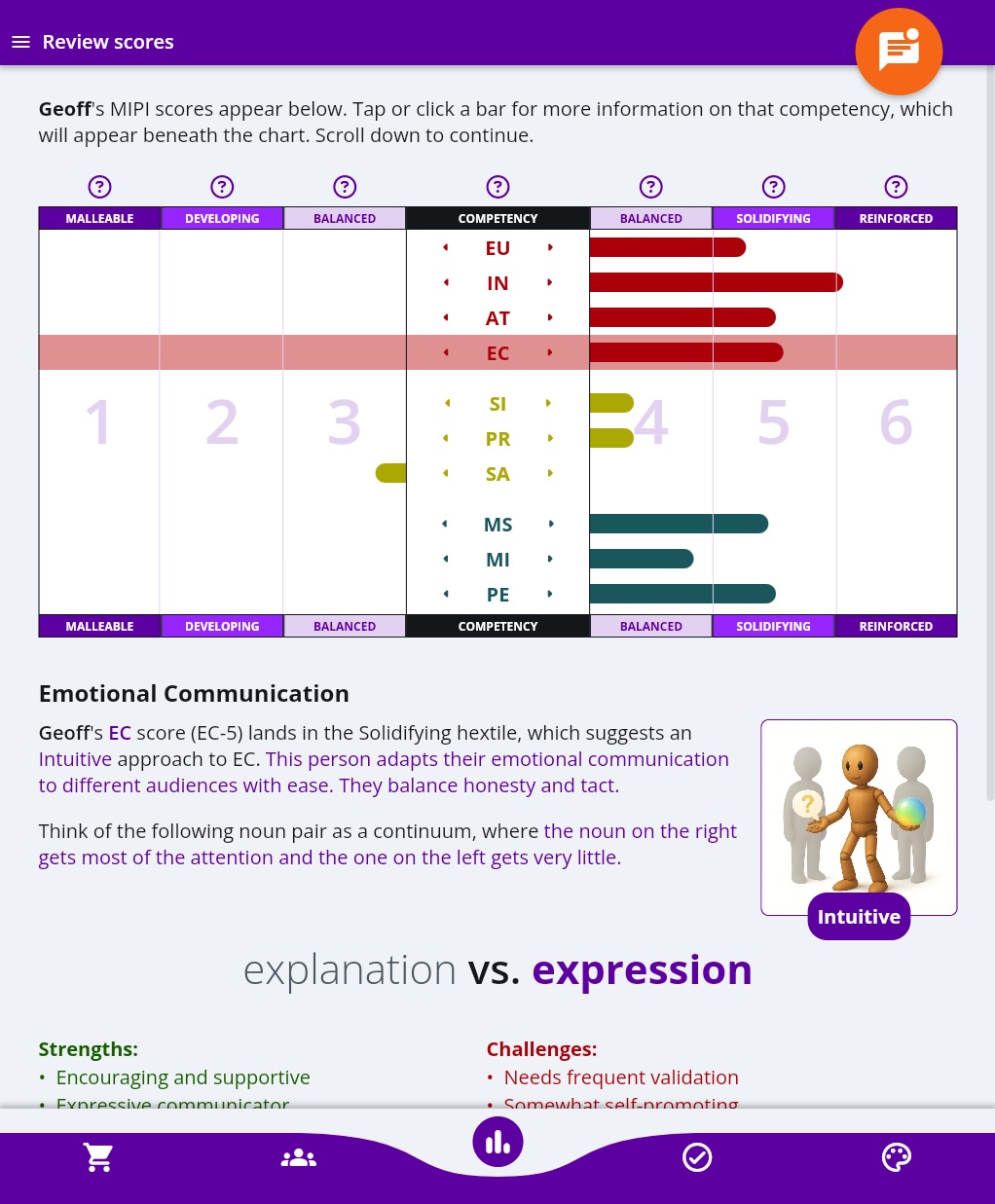
EC · Emotional Communication
I feel things. I just cannot get them into words.
People know something is wrong, but not what it is.
I respond by fixing instead of naming.
Emotional CommunicationEmotion in words
I can feel too much of the room too quickly.
I say more than the moment can really hold.
Other people’s feelings pull me off my own footing.

Left-facing need

Find language for the feeling

This side often looks like muddy self-description, delayed articulation, or a person who can sense something is happening but cannot get it into communicable form. They still respond to important moments, but may do so through withdrawal, fixing, deflecting, or indirect signals instead.

What this side often needs: more precision, more emotional language, and safer rehearsal for turning inner data into something another person can actually understand.

Click for more details

Right-facing need

Bound and regulate the signal

This side can look like saying too much too quickly, carrying too much of other people’s emotion, or losing fit because sensitivity outruns boundaries and timing.

What this side often needs: more calibration, more boundary clarity, and more choice about when to lean in, when to pause, and how much of the room to take in.

Click for more details

Selected practices

Emotional Communication in both directions

Emotional labelling

This fits when the bottleneck sits before or during expression itself and feeling needs clearer naming before it can be shared.

  • Corpus activity: `Emotional labelling` maps to `EU` and `EC` with affect recognition, emotion labelling, and emotional differentiation.
  • Contexts where this may come up: vague emotional self-description, conflict that gets flattened into irritation, and inner states that are felt but not yet speakable.
  • Supporting literature: Lieberman et al. (2007) and Torre and Lieberman (2018).
AT · Attentiveness
My attention keeps leaking away.
I keep re-entering the same task from scratch.
Too many loose ends are pulling at me at once.
AttentivenessUsable attention
I get stuck inside my own thoughts.
I monitor so much that I lose the thread.
Every interpretation grabs more attention than it deserves.

Left-facing need

Hold the line of attention

This side often looks like repeated drift, messy re-entry, detail loss, or work that gets broken apart by every competing cue in the environment. The person still tries to cope, but often ends up relying on stress, frantic catch-up, or sheer memory load.

What this side often needs: more structure, better re-entry support, and clearer ways to protect focus once it has been established.

Click for more details

Right-facing need

Create distance from the signal

This side can look like overmonitoring, getting stuck inside recurring thoughts, or becoming so captured by internal interpretation that workable response gets harder to access.

What this side often needs: more metacognitive distance, more selective engagement, and less automatic obedience to every thought that grabs attention.

Click for more details

Selected practices

Attentiveness in both directions

Distraction capture list

This fits when continuity is fragile and attention needs a safer way to park interruptions without losing the main thread.

  • Corpus activity: `Distraction capture list` maps to `AT`, `MS`, and `PE` with selective attention, working-memory maintenance, and goal shielding.
  • Contexts where this may come up: interrupted work, loose-end overload, and attention that keeps breaking because every cue demands immediate handling.
  • Supporting literature: Achtziger, Gollwitzer, and Sheeran (2008) and Monsell (2003).

SEE IT TOGETHER

The model, the system, and the library do different work

What makes this distinctive is not just quantity. It is that the materials are organized around directional developmental problems, compensatory patterns, and fitted use contexts rather than loose topic buckets alone. The Framework, the Atlas, and the Library each make a different part of that picture legible.

The Framework

The primary engine thar drives all of our work. Explains the competency architecture itself.

The Atlas

Shows how the wider system translates lived difficulty into fitted interpretation and next steps.

The Library

Shows that the applied layer is real, directional, and already populated with practical materials.